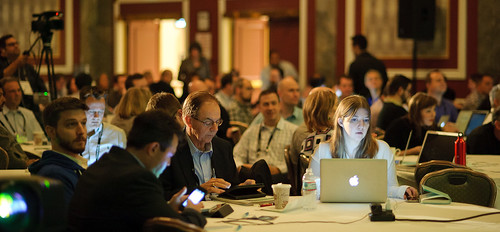
It’s not easy being the New York Times‘ public editor. At a recent talk I attended, Arthur S. Brisbane said, half-jokingly, that few people at the Grey Lady want to have lunch with him. But the criticism from outside the paper’s 8th Avenue offices can be just as blistering.
Culture
If you believe the hype, printed books are going to follow newspapers into the dustbin of history. But I think that books, like newspapers, won’t die off completely. They’ll just become niche products, consumed by a small, but avid, group of people who still love the medium and find their digital equivalents lacking.
Nothing illustrates the magic of a physical book like this fun stop-motion video from Toronto independent bookseller Type Books.
Ironically, the fact that books are becoming a niche product will revive the fortunes of the small, independent booksellers who have been hammered over the last 10-15 years by competition from major chains. If they are smart, the independents will remain nimble and provide services that the Amazons of the world can’t: namely, curation. Type, for example, leans towards architecture & design, although they do carry a decent selection of general fiction/non-fiction. The reason they remain a going concern is because the owners have successfully identified the kinds of books read by people who love physical books, and they aggressively stock those.
Note that these two qualities aren’t inexorably linked. I’m waiting for the day when an independent bookstore offers e-books alongside their physical products, thereby enabling them to both serve a niche via actual books, and a general audience via digital download. However, such a day will not come so long as e-readers like the Kindle are closely tied to a major chain, with all of the DRM shackles that such an association implies. How long before we see a truly open-source e-reader? And what aspects of the bookselling market will need to change before that happens?
Yesterday, Poynter reported that the Associated Press and 28 other news organizations have launched NewsRight, “an ambitious venture to license original news content and collect royalties from aggregators.” Ambitious is right. The fact is, articles no longer have significant monetary value; otherwise, a system like NewsRight wouldn’t need to exist. AP and other legacy media organizations are trying to reverse a trend that’s irreversible.
This morning’s Wall Street Journal contains an article about Kodak’s imminent bankruptcy declaration. My only question was: what took them so long?
Continue reading…
Yesterday evening, a few of my CUNY journalism school classmates and I attended a lecture by Brooke Gladstone, host of WNYC‘s excellent media-analysis program, On The Media. Her new book, The Influencing Machine is an analysis of journalism in the modern age, told in graphic novel format. Unsurprisingly, she spent most of her talk discussing bias in the media, and how to counterbalance that with disclosure. Continue reading…
After ten years in IT, I’m changing careers. In the fall, my wife and I are moving to New York City, where I will be starting an M.A. program at the CUNY Graduate School of Journalism.
I wouldn’t be taking this step if I didn’t believe that the future of journalism is bright. I realize that my optimism flies in the face of popular opinion, particularly amongst those who bemoan the increasingly desperate state of the newspaper industry. The coming decades will bring a different type of journalism than exists today, but the fundamentals of news won’t change. World events will still happen. People still want to know what is happening in their communities. And finally, they will still want quality and accuracy, because they’ve been used to it for so long. The big questions for media organizations, large and small, are how to fulfill these demands without going bankrupt, or paying journalists below-subsistence wages. Continue reading…
The advertisement on the back cover of this month’s issue of the Columbia Journalism Review struck me as astonishing. Here it is:
Remember, CJR is a magazine targeted at journalists and journalism educators. So let me get this straight. Kimberly-Clark has spent a substantial sum of money to place an ad exhorting journalists to help protect their brand by ensuring Kleenex is only referred to as "Kleenex ® Brand Tissue?" Does this strike anyone else as insane? Or is this to be seen as a shot across the bow — hacks, here’s your fair warning, and if you don’t refer to Kleenex (excuse me, Kleenex ® Brand Tissue) by its proper moniker, you risk being sued?
I’d be interested in knowing if this ad made others uneasy.
Toronto’s municipal election will be held on October 25th this year. With sixteen days left in the campaign, I’m astonished that Rob Ford is the mayoral candidate leading the pack. For those of you not living in Toronto, Ford’s controversial record as a councillor stands on its own.
Ford, and many other candidates that run on a platform of cost reduction, rely on the fact that voters often can’t visualize the difference between $1M and $1B. Without a sense that these two figures are three orders of magnitude apart, it’s easy to think that halving the number of Councillors (which will save $2.25M per year) will have a significant impact on Toronto’s debt load (somewhere in the $3B range).
A while ago, while looking into the "quantitative easing" that the US Federal Reserve is engaged in, I came across the following excellent visualization of the difference between $1M, $1B and $1T dollars. Have a look.
Much ink, digital or otherwise, has already been spilled about The Globe and Mail’s recent redesign. The end product mirrors a great deal of what the San Francisco Chronicle did last year with its redesign; a long-term contract with Transcontinental, a set of new digital printing presses that would permit glossier stock, a smaller form factor, and colour on every page. The end product is definitely beautiful. But that’s like complimenting your neighbour on his fine new team of horses when the Ford Model T is already revolutionizing transportation.
Continue reading…
I’m pleased to present the first episode of my podcast, The Ephemera Report, featuring an interview with Allan Symons of the Canadian Clock Museum in Deep River, Ontario, the town where I grew up. Check it out!